Showing posts with label Iraq. Show all posts

Friday, 4 December 2015

the haters are here

After the vote this week on action in Syria, the result of which I was very pleased to see (and Jeremy Corbyn was not, it appears) Labour MPs who voted with the Government, and some others who did not, have received death threats. Oh yes, pictures of guns and such like. One at least is under police protection now.


Do they think this is new? It is not. I was sent pictures of guns and knives, and gun-related pornography, and threatened with rape and murder, a number of times when I was an MP, and not to do with my vote on action in Iraq (in favour, since you ask). On the latter I had a lot of tedious whining from people who read the Guardian and didn't give a stuff about the slaughter in Iraq, and also some pacifist representations from people who thought there should be no military action anywhere, ever, by anybody. This last laudable, but impossible. No, the death threats came - you are ahead of me - when I mentioned Israel, which I did not do very often. I am a Zionist, but did not and do not go on about it. Also, ten years ago and more Jew-hatred was not so much in evidence on the left in the UK as it is now. But it was there. The death threats also came, slightly to my surprise, after I left Parliament (in 2005), and related to my support for Hillary Clinton rather than Barack Obama as Democratic candidate for the US presidency in 2008. I didn't expect misogynist hatred from that quarter, but I got plenty, and it was pointed out to me that Americans have guns, and that those guns would be used on me if I didn't shut up.


Well, I didn't cry about all that. I didn't like it, but I didn't cry. I certainly didn't ask for police protection. How wimpish is that? In my time an MP was seriously injured and his staff member killed by a mentally ill constituent with a samurai sword. Anyone in public life puts themselves in that kind of danger, and of course precautions must be taken, especially to protect staff. But - if you can't stand the heat, stay out of the kitchen, as someone once said. And if you don't make any enemies, it means you've never done anything. I don't know where the idea came from that we should all live and work in safe spaces. There are no safe spaces, and arguably if we try and keep ourselves safe all the time we place ourselves in more danger than if we don't - because we then think that nothing will ever happen to us. Yes, it might.


In my time communication was by email, and not everyone used even that. But I saw straight away that people were more willing to use hate speech in an email than they would have been in a letter, on the telephone or in person - though there was some of all that too. Even more so now, on Twitter. In public life you just get used to it. There's no rule that says everyone should be nice to you if you are an MP. In fact, to think that people should be nice to you borders on the narcissistic.


On Iraq (and there are similarities with the situation today as regards Syria, whatever anyone says) I voted with the Government, for military action, and never lost a moment's sleep over it, because I believed it was right, and was glad to have the opportunity to vote that way. I was very clear about that publicly. But there were still foolish letters in the local newspapers berating me for not voting with my conscience. As if voting with your conscience always means voting against the Government. I am glad I did not have to suffer the torments my neighbouring Labour MP Martin Salter had to at the time, desperately juggling two conflicting stories - in Westminster he said he was trying to persuade recalcitrant Labour MPs not to vote against the Government, because he wanted a government job to be helpful to Tony, and in Reading he said he was voting against the Government in line with his convictions and to appease the mosque show the people of Reading that he was on their side and not the Government's. In the end he was forced into the impossible position that everyone is forced into who tries to run with the hare and hunt with the hounds - he abstained on the vote, lied publicly in Reading about how he had voted, and was forced to stand down in 2010 when the issue refused to go away. I had none of that. I pretty much always tell the truth, not because I am especially virtuous but because it's so restful. You never have to keep your story straight or remember what you told the last person.


So, MPs who are worried and upset about the hate they are getting, and about possible threats to themselves and their families - relax. You probably don't need police protection. Once your home address becomes public you must either move house or put in very serious security measures, naturally. And vote with your conscience. It's the easiest way.

Friday, 20 November 2015

Shawcross and his unfashionable views

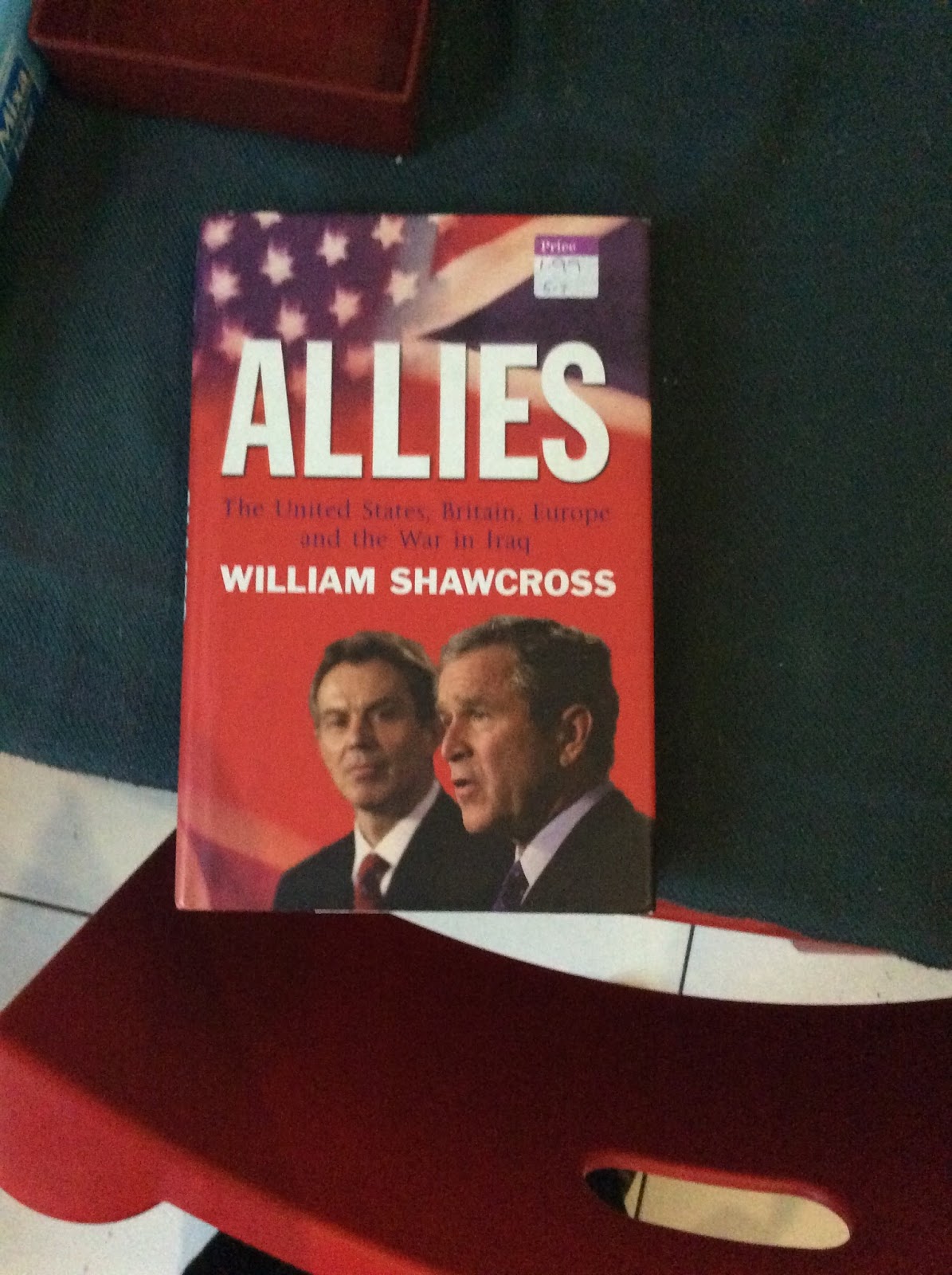
This book, by William Shawcross, who is an intellectual and (kind of) a part of the Establishment in the UK - I know there are many who do not like his writing, but I do - was published rather a long time ago, after 9/11 and after the invasion of Iraq by the US-led Allies, but not long after. It took some work to track it down once I became aware of its existence. The views and ideas it contains were unfashionable at the time, and not only among the complacent chattering Guardianistas, who unfortunately are still with us, but broadly unfashionable in every sense, which is why the book sank without trace. I think I paid about a euro for it from some obscure book dealer, after Amazon tried to tell me it was unobtainable. A pity. I don't like buying second-hand books, especially if the author is still alive, as the creator of the work gets nothing from it, and Lord knows it's hard enough to get paid to write anything at all. But it is worth reading this book, I promise you, even if your prejudices, fully formed beliefs, intellectual worldview, whatever, compel you to think he is wrong.

It starts this way: "The Arab narrative of the 'Fallujah butchery is ... pernicious nonsense." About 270 were killed in Fallujah, almost all of them fighters, almost all of those former Iraqi army officers under Saddam. He quotes the Iranian journalist Amer Taheri on the killing of the American hostage Paul Johnson at that time: "Paul Johnson was killed by lies spread by Arab elites ... he was killed by the over 1,500 Arab lawyers who have volunteered to defend Saddam Hussein but who were nowhere to be seen when he was engaged in genocide against the Iraqi people." Shawcross says "Saddam may not have been an immediate threat but he was an inevitable one." He notes (in his preface to a later edition) that the Arab Spring had its harbingers here, in 2003.

UN weapons inspectors were banned from Iraq in 1998, and the Allies bombed Iraq that year. Remember that? Remember the millions marching against it? Nor me. One member of my local Labour Party at the time timidly approached me to express disquiet about the bombing of a sovereign nation. But only one. UNSCOM's final report on this, in 1999, said that vast numbers of WMDs could not be accounted for. Shawcross goes so far as to give the need to contain Iraq in the 1990s as the reason for the presence of US troops in Saudi Arabia.

Shawcross is good on the humbug there is about the "neocons". At the time of that liberal hero JFK's presidency, in 1962, a legal opinion given by the Justice Department noted "the UN Charter does not prohibit the taking of unilateral preventive action in self-defence prior to the occurrence of an armed attack." No. It did not so prohibit then, and it does not now. Shawcross concludes "Surely everyone would agree that it would have been better if the United States had pre-empted 9/11 by confronting Al Qaeda and the Taliban before September 2001. There was ample cause." Yes.

Very few European intellectuals saw 9/11 as a threat. One who did was Ralf Dahrendorf (contrast the late Gunter Grass) who said that first, Western values do exist; second, power is needed to defend them; third, defence might have to be done by force of arms. Michael Ignatieff and Bernard Kouchner were two others who took this view.

"The Iraqis could not change their own tyrannical government; only outside intervention could do that. There was no better case in the world for such intervention. Tony Blair himself put the issue succinctly later when he told the House of Commons, 'When people say to me, why are you risking everything ... on this issue? I say I do not want to be the prime minister at whom people point a finger back in history and say: 'He knew perfectly well that the threats were there and he did not do anything about it.'"

I cite this book, and quote from it, to indicate that what "everyone" knows, and what "everyone" thinks do not really exist. What you think, and what I think, may differ. We may both find equally sound and convincing bases for our views, and argue them effectively. But a plurality of views there always is, and this must continue. At this time, soon after the savagery of the killings in Paris, and as I write in France under a state of emergency, there is a dismaying chorus of voices, at least in English, informing us what "everyone thinks" and what "everyone knows" - usually that such killings are the fault of "the West". That the Bataclan murders are France's fault for conducting air strikes on Islamic State. Leave them alone and they'll leave us alone. Idiocy. they have already declared war on "us". Hoping they'll leave us alone is like feeding a lion, in the hope that it will eat you last.

The West is at war,whether it wants to be or not. That war started a long time ago. It was formally declared much later, in the 1990s, and Bill Clinton did more or less nothing about it. It was stepped up in 2001, and it has been going on since. You and I cannot save ourselves from attack by Islamist terrorists. But if we shut up, if we blame the West for the attacks, if we say in Nick Cohen's ironic words "Kill us, we deserve it", we are complicit in the ultimate victory of the death-loving barbarians.

As I write there is a hostage crisis in Bamako, Mali. It is taking place at the Radisson Blu hotel in that city, whose guests are not that likely to be Malian farmers or workers. There are signs that it is about to be resolved without the bloodletting we saw in Paris a week ago. I hope so. But hey, that's only over there in Africa.

Wednesday, 10 April 2013

Iraqi heroism

in the struggle against the dark forces that sought to overthrow the people after 2003, and which offered not a better future but only death, has not been recognised enough, according to Paul Wolfowitz in this article. Highly recommended. Thanks Julie Anna for bringing it to my attention. Now I look forward to positive debate about the future for the region. Anyone? anyone? *sound of tumbleweed*

Sunday, 10 March 2013

Iraq ten years on (sigh)

No, I'm not going to write about WMD, and not even about the red-socked fop "Sir" Christopher Meyer, who has weighed in with Tony-hatred. Anyone who reads me regularly will know that I am a liberal humanitarian interventionist who supported the action in Iraq and voted for it in 2003 and who still thinks it was the right thing to do. I won't rehearse the arguments here, though I will remind that there have been several independent judicial inquiries - some people want to keep having inquiries until they get the result they want - none of which have concluded that anything criminal or in breach of international law took place. There are two main issues I still cannot understand or deal with. The first is the notion of "us" and "them". You still hear it today. "It's not our war" and similar. Well then, who are "we"? White people? Christians, or not-Muslims? Guardian readers? And who are "they"? People with brown skin? Muslims? Arabs? People who do not live in the UK or, perhaps, north America? Apart from anything else, that argument does not reflect the reality and the diversity of "Western" populations. Are we one human race, or are we not? And if we are, then how can we tolerate the mass slaughter of people by their rulers? As is happening in Syria now, and has happened in Burma, and plenty of other places than Iraq. And if we are not, but are to be divided along racial, religious or other lines, please explain to me how that should work, and tell me where it leads. I think there are enough parallels in twentieth-century history, in Germany, Rwanda and Bosnia, to give us some clues.

The second difficulty I have is the belief, or argument, used by those who protested and marched against the war back in 2003. If you don't think your government should send troops into military action because you believe the cause is wrong, fair enough. In this case I would not agree with you, but that argument is at least coherent. But the marchers, or at least those claiming to speak for them, never used that argument. "Not in my name", they shouted. And yet they lived in democracies, where their governments acted precisely thus. In their names. That's how democracy works. If you don't like your government's policies, you can let them know it. And vote for someone else next time. March in Saddam's Iraq and see how far you get. Or in Venezuela today, come to that. I watched one of the marches, in Glasgow as it happens, in February 2003. Around one in five of the marchers, by my estimation, were waving the flag of Saddam's Iraq, and some of them had pictures of him. Why were they doing that? Did anyone reading this march ten years ago? Did you wave an Iraqi flag or a picture of Saddam? If you did, please get in touch, I'd like to know why you did it. I'm definitely missing something here.

Saturday, 23 February 2013

genocide

my eye fell on this post by Robert Halfon, Tory MP for Harlow. A man whose name I have heard quite a bit lately. He asks, whose story today is the most similar to that of the Jewish people, in terms of persecution, marginalisation, genocide and revival? The answer might surprise you, he says. But the answer was immediately obvious to me, and no surprise. The Kurdish people. Their homeland, if they can really be said to have one, is in Iraq, and Turkey, and neighbouring places. They have in effect their own nation now in Iraq, built on the mass graves dug by Saddam's slaves. In this context I would highly recommend Michael J. Totten, who, unlike so many who pontificate about the region, has actually spent a lot of time there and talked with many of the major figures. There is to be a debate in the House of Commons on recognition of what was done to the Kurds as genocide. The debate is to take place on 28th February. If I were in London I would be in the Strangers' Gallery to hear it. As I am not, I hope person or persons will live tweet it for my benefit. Oh and Robert Halfon, if you are ever in Strasbourg, let me buy you a cup of coffee or a glass of the finest Alsace pinot blanc, and shake you by the hand.

Tuesday, 29 January 2013

the last liberal

I don't post often about American politics, largely because I am not very knowledgeable about it. But there are those in that world I admire, and Joe Lieberman is one of them. Read about him here as he prepares to leave the Senate. He is loathed by most of his erstwhile party, the Democrats, for supporting the Iraq War. Well, I have nailed my colours to that particular mast many times, so it will not be news to readers that I supported the Iraq War, that I voted for it enthusiastically in the House of Commons in 2003, and that I was, and remain, a Blairite and supporter of intervention in furtherance of democracy, human rights and the rule of law. I haven't always been that way, and went into the Commons in 1997 quite a long way from there. But it was Tony Blair, his leadership and especially the Chicago Doctrine, that helped me to see things differently.

People outside politics often forget, or do not realise, that there is such a thing as voting and acting on principle when that principle leads you to support the government of the day - and that voting against, or publicly opposing, the leadership line is not always principled, but is often done for cheap populist reasons. Joe Lieberman has always been a principled politician. In the end he stood, and won, as an independent. Perhaps there is a lesson to be learned from his political career. Maybe if you don't trim to your party's line, if you can't or won't, then outside the party is the place to be.

Wednesday, 10 October 2012

lack of intervention leads not to peace but war

in Syria, of course.  The shameful lack of intervention to stop the slaughter of Syria's people by its government has had regional repercussions which were not hard to foresee.  I speak of course of the Kurdish issue.  Turkey's brutal suppression of its Kurds is well known, and Syria has previously been helpful in this, booting the PKK (Kurdistan Workers' Party) leader Abdullah Ocalan out of Damascus and enabling him to be arrested and extradited to Turkey, where he remains, serving a life sentence which will never be commuted.  But now, as the regime in Syria becomes increasingly savage and desperate, the various Kurdish groupings in the region, most of which do not trust each other or work together, are mobilising, to Turkey's dismay.  There have already been shootings and shellings across the Turkish-Syrian border, and there will be more.  With each Turkish life lost the rattle of the sabres is louder.  But NATO is deaf to it.  Turkey invoked the NATO charter this week, but was more or less ignored.  You can read a good piece by the excellent Michael Weiss here.

NATO's geopolitical reasons for its unwillingness to support its member state, Turkey, are for it to explain.  But it is worth noting that the only place in the wider region where the Kurds live at peace, not much repressed, and with a measure of self-determination, is Iraq.  And it was intervention that gave them that.

Wednesday, 19 September 2012

In the Wake of the Surge, and Where the West Ends

by Michael J. Totten, a journalist and writer I discovered through World Affairs Journal.  'In The Wake of the Surge' is a group of dispatches from Iraq following the stroke of strategic genius that was General David Petraeus' decision to create a "surge" of troops in Iraq to finish the job.  It worked.  The dispatches are fascinating.  Most of what is said about Iraq is said by people who have never been there.  Even if they have they do not know the country or many people.  For example, the Kurds.  Who, as I predicted years ago, led the Americans to Saddam Hussein (who, incidentally, had a great death, ranting at the world with a noose round his neck until they led him away to be hanged, unlike Colonel Gaddafy, who was pulled from a hole in the ground and shot like the mad dog he was).  Iraqi Kurds like the Israelis, and the Americans.  They don't like Arabs.  At all.  And no-one is their friend.  The mood in Iraq changed, after 2003, and changed back again more than once.  But Iraq is now one of the more stable countries in the region.   These dispatches are valuable because although every now and again Tony Blair pops up to put the Guardianistas right,he shouldn't have to do it all on his own.

'Where the West Ends', somewhat by contrast, is another series of essays or dispatches, but interestingly is about the notion of "The West", or "us" as the racist Guardian calls it. Where does it end?  How do you know when you are in it?  Because the essays have this theme, they are more than just a road diary.  In Iraqi Kurdistan the writer's companion takes a picture of a laser scanner in a shop, because it is one of the few things there that remind him of home.  "Iraq is the only country in the world where Kurds wield any power".  So it seems.  In the Balkans, where I have travelled too (I have never been to Iraq) he is clear that we are in Europe.  Myself, I thought parts of Serbia seen from the train were not very European at all, but there we are.  He cites Churchill, "The Balkans produce more history than they can consume", which has to be right, and frighteningly, Radovan Karadzic, "Sarajevans will not be counting the dead.  They will be counting the living".  Which is right too.  Readers know the place in my heart occupied by Sarajevo.  His travels in places in Serbia and Bosnia not frequented by tourists, in 2008, produced some ugly anti-American behaviour from Serbs.  Tony Blair was a hero to the non-Serb Kosovars, but although identified as British I received nothing but kindliness and courtesy from Serbs in both those countries in 2009.  Totten also remind us that Arab jihadists, who went to Kosovo to fight against the Serbs, were "tourists with guns" who had no effect on the outcome of the war.

These American travellers did seem a little naive.  They could not read Cyrillic, so got lost in Serbian Bosnia because they could not read the road signs.  They were anglophone and expected others to speak English, as Americans tend to do.  I did not go so far off the beaten track as they did, but I still needed my cod Russian to help me communicate, and my ability to read Cyrillic (which is not hard to do) helped a LOT.  These two went to McDonalds so they could point at pictures of food.  I never had to do that - and in former Yugoslavia you can eat very well.  They were even surprised to find that in Montenegro, where hardly anybody lives, there are not many street lights.  Why would anybody light the roads there?  "When the future of Yugloslavia looked dim and precarious, Slobodan Milosevic looked for a way to rise in [sic] power and keep it.  He found one when he transformed himself from a communist apparatchik to a Serbian nationalist."

Present-day former Yuglosavia (a concept I fear we are stuck with) is more interesting politically than most people think, as Totten shows us.  Macedonia, two-thirds Christian in population, has made common cause with the Wahhabis, mainly so that they can call their Albanian minority, who are hated by the Wahhabis, terrorists.  And remember (most don't), that well after the break-up of the former Yugloslavia, in 2001, there was actually a civil war in Macedonia.

The Caucasus, a trouble spot for centuries: "Russians are as prone to cognitive egocentrism - the projection of one's own psychology on to others - as everyone else", coupled with "Where does an 800-pound gorilla sit?  Wherever it wants".  Gallup International, in a 2004 survey, identified Kosovo, Afghanistan, Israel and Georgia as the most pro-American countries in the world.  And this was before the 2008 invasion of Georgia by Russia, which invasion was, mysteriously to me, much applauded by some commenting on this blog at the time.  Totten uses more than once the term "geopolitical spa" about countries where Americans can take a bath in water not tainted with anti-Americanism (this is a metaphor).  He finds some quotes and sources which have led me to take a lot of notes for further reading.  They include Ukrainian emigre Wasyl Hryshko, who describes Soviet collectivisation in Ukraine as "the first instance of peacetime genocide in history".  If Totten wonders where the West really ends, he finds its end very close to the borders of the EU, in western Ukraine, where he was shocked by the decrepitude and lack of hope he found.

Read these.  They might make you think.  And if they don't your mind is probably closed.

Monday, 13 August 2012

Kurdish issues

outside my workplace there is a permanent vigil, so described, for Abdullah Ocalan, leader of the PKK (Kurdistan Workers' Party) who is serving I believe 99 years in Turkey for terrorist offences.  They say they will stay there until he is released.  They sometimes march and chant, and a couple of times have got into one of the buildings.  Well, Ocalan is never coming out, is my firm belief.  The Kurds are the largest population group in the world without a country, and as they are in the Middle East, and Muslim, but not Arab, and as they are, pretty  much, hated by the leaders of all the countries they are in (with the possible exceptions of those unlikely bedfellows Iran and Israel), it's going to be difficult for them to find one.  There are of course emigre Kurdish communities in most of the world, including the neighbourhood I live in in Strasbourg.  Successive conflicts, persecution and massacres have driven them away.  Michael Totten has spent a lot of time in Iraq, including with the Kurds there, and has written some interesting dispatches which he has now edited into a book "In the Wake of the Surge" which is worth reading.  Like me, he was plunged into profound gloom at the slaughter which took place after the overthrow of the Saddam regime, and depressed by the gleeful Guardianista wallowing in gore at that time.  But the surge, the brainchild of General David Petraeus, did the job, and Iraq is stable now, much more so than many in the region.  Totten cites an index of liberties which places Iraq third in the region (not including Israel in the count, obviously) after Lebanon and Morocco.  Unlike me, Totten has spent years in the region, is well connnected there, and has a deep knowledge of the politics and issues.  So, while he may not be right about everything, he is writing from experience and what he has seen, rather than from Guardian editorials as too many do.

Anyway, the Kurds have a measure of self-determination in Iraq now.  Good.  They like the US and Israel and are cheerfully, and disgracefully, racist about Arabs from anywhere.  Women are not covered ,and the sexes mingle socially.  Opposition parties and media flourish.  Iraqi Kurdistan is not a paradise - there is huge corruption - but I'd rather visit there than, say, Saudi Arabia.