as John Lennon once sang. A very long time ago. I visited Gibraltar once, also rather a long time ago, and I remember that the Gibraltar government spokesperson continually referred to members of the delegation I was with as having "flown down" to Gibraltar - i.e not having gone in through Spain. One or two members of the delegation did in fact choose to enter Gibraltar through Spain, to demonstrate that they believed Gibraltar was part of Spain. But they could only do this because both Spain and the UK were, at the time (1998) members of the EU and thus obliged to keep their borders with other member states open. Before that, in the 1970s and 1980s, when the UK was a member of the EU but Spain had not yet joined, there was harassment by Spain at the border, with consequent difficulties for the Gibraltar economy. Before that, when neither the UK nor Spain had yet joined the EU, the border was blockaded and there was regular sabre-rattling by Spain. But at no time even then did Spain actually try to occupy Gibraltar militarily by force. They didn't dare.
As soon as the UK formally leaves the EU Spain can close its land border with Gibraltar and also blockade it by sea. The UK would then have to respond in some way, in the interest of the British people of Gibraltar, who have as we know chosen to remain British whenever their opinion has been asked. However, that does not mean war. One Spanish soldier's boot across the border, or one shot fired into Gibraltar from a Spanish gun, would however oblige the UK to retaliate on behalf of its citizens. As Michael Howard said yesterday, Theresa May as prime minister would have no choice. This is simply how it is. Spain knows this very well. Why has Spain never tried to take back Gibraltar (ceded to Britain in perpetuity by the Treaty of Utrecht) by force before? And what happened when another state occupied a British territory, 35 years ago this week? Some of us remember the Falklands.
I make no remark on the merits of all this, or indeed of the Treaty of Utrecht. Bismarck I think it was who coined the term Realpolitik.
Monday, 3 April 2017

Sunday, 2 April 2017
RIP Darcus Howe
I was sorry to read today of the death of Darcus Howe, aged only 74. He was one of the great activists for black rights of his (very big) generation. Like most of that generation he had been a collective activist, and was an intellectual. Things have changed a bit in recent years. I wouldn't presume to say much about the politics of race, in Britain or anywhere else, but I'd like to say that I read the New Statesman for many years, and was always stimulated, often entertained, and sometimes educated, by Darcus Howe's weekly column in that organ.
At a certain point around the year 2000 Darcus Howe began to cooperate and work with Blue Sky, an arts and cultural organisation based in Reading. I had some concerns about this organisation, not especially about its activities as such but about the transparency of its funding, and relayed those concerns, not publicly but to Reading Borough Council, which supported Blue Sky at times and in various ways at the time. I had no issue at all with the work Darcus Howe was doing with them.
For context, there was a shooting in 2002 from outside a Reading nightclub, The Matrix (since closed) which put a member of club staff in hospital for months. Following this, Blue Sky hosted a debate on guns, in Reading, presided over or spoken at by Darcus Howe, to which I was invited as the then constituency MP. I accepted the invitation but subsequently had to give apologies, for reasons I cannot now remember but which had nothing to do with the merits of the event. Another Reading MP, Martin Salter, got wind of the event and did attend. This was his first recorded interest in any issues of interest to Reading's black communities, despite the fact that the vast majority of those communities lived in his constituency of Reading West, which is not where the shooting took place. Mr Salter had a word with Darcus Howe, whose next New Statesman column informed his readers that I had refused to attend the event as I disapproved of Blue Sky and its work on guns and race. Darcus Howe went on effectively to call me a racist. You will not find the article on the New Statesman website, not surprisingly. However, once I had contacted libel lawyers Peter Carter-Ruck and Partners Darcus Howe published this column, which ended thus:
Further to last week's column, I wish to make it clear that Jane Griffiths MP did not express reservations about Blue Sky Arts's guns debate in Reading. On the contrary, Ms Griffiths accepted an invitation to attend. I apologise to her for my error.
An apology and costs.
I happened to meet Darcus Howe at Labour Party Conference later that year, and he treated the matter with dignity and humour. I just wanted to place that on record.
Saturday, 1 April 2017
Harriet tells it
Here is the short review of Harriet Harman's memoir 'A Woman's Work' I published on goodreads recently.
This is readable and engagingly written, which is more than can be said of all, or even most, political memoirs. It's also less self-serving than most of them are. At times I was a little exasperated that she was so down on herself. Yes, she was sacked from the front bench, but most government ministers get fired in the end, either by the prime minister or by the electorate. She did it all for the cause of women, and has been utterly honest about that throughout, which again is more than can be said for most politicians. She is of the same generation as me - I am four years younger - and she is a better and more dedicated feminist and politician than I have ever been. Harriet I salute you.
She writes: "the reality is that an MP who gets in with the help of people higher up in the party is not as good an MP as someone who's fought their own way in. You'll never be up to the task of standing up for your constituents if you can't stand on your own two feet to get selected." And on all-woman shortlists: "it was definitely one of those things when the end justifies the means". In later years, as she herself has aged, she has begun to take up the cause of older women, and notes, interestingly; that "often, as older women, we are invisible even to ourselves". The younger front-bench women are much more noticeable, not just to the media but to their own colleagues, than the older ones even though the younger ones are in a minority.
I would say to any young woman who is considering going into politics, read this book. Harriet Harman was clearly mercilessly and misogynistically bullied throughout her career, and this is quite likely to happen to you too. But Harriet Harman has been instrumental in some of the cultural changes that make life better now for women in politics. We push this boulder up the hill, and at times it falls back on us and threatens to crush us, but with each new heave it gets a little further up that hill.
No one said it would be easy. But it has always been easier for men.
Friday, 22 January 2016
new year travelling: Year Zero in the Khmer lands
as I have posted previously, changes gonna come. Be careful what you wish for ... in spring last year I was thinking that my life was in a bit of a rut and I needed to make some kind of change, but could not think what. The cancer scare that turned out not to be, but likely to be within five years, was part but not all of that thinking. I didn't know then that significant other was thinking just the same thing, and wishing for something to change. He didn't have the quantity or quality of work he wanted to do in Strasbourg, and I did but was feeling trapped and hoping to do something different before retirement and consequent loss of income and/or health problems caught up with me. Well, with that, significant other was offered and accepted a job in Cambodia. He went off in June to do the summer work at a UK university he has done for the past few years, came back in September for three days, and went off again to Cambodia for a year. At least. He left all his possessions for me to sort out and put into storage, without even mentioning them before he left - and he is a hoarder and I am very much not - but that is another matter. So I put our place on the market - we had discussed this - and asked to work at 90% of contract instead of full time for 2016. This was agreed, so I carry on working as normal, except that I get another 21 days' holiday for this year. I took 31 days' leave, starting on 8th January, and flew off to join him in Cambodia. I have always wanted to be a trailing spouse, and this is as close as I am going to get at my age.
I had never been to South-East Asia at all before coming here. Er, it's hot. Cambodia is tropical. Half the year in an oven and half in a sauna, they say. This is the oven half. I chose this time of the year to travel here because (1) the Alsace winter is no fun; it's more the dark than the cold that's hard to bear (2) in January and February there's nothing much to do on the allotment. Our place is sold - the keys were handed over 48 hours before I left, and the last three days in Strasbourg spent in a hotel - so with no housing or utility costs for the next few weeks, and significant other with his own flat, it was feasible for me to travel and stay there for a while. So, hey, a big change.
We know the history of Cambodia, or we think we do. The Killing Fields, the Khmer Rouge. It was 40 years ago, thus in living memory. In Phnom Penh, and elsewhere, you quite often see people with no foot, no leg, or no arm. They are all, pretty much, or appear to be, fifty-something. You don't see many others that age at all. About a quarter of the population was lost to starvation, murder and death by forced labour. Genocide, let's not mince our words. The effects are still felt now, as the intellectuals were killed first and the universities closed, meaning that when it all reopened there was no one much left to do the teaching. If you were alive and could read and write after that you could teach, so quality education is only starting to be available now.
Anyway, enough of the history. Others have written it better than I could. I'm currently reading Ben Kiernan's 'How Pol Pot Came To Power' (pub. 1985, updated 2004 - an academic history which is readable and a good source book) and in the first few days I was here I re-read Margaret Drabble's 'The Gates of Ivory' (pub. 1991 - the Kiernan is in the bibliography: a novel which is full of great stuff and picks up most of the characters from the earlier two in her trilogy 'The Radiant Way'). Recommended. The late Doris Lessing wrote somewhere that her generation (born in the 1920s and 30s, the one before the boomers, with the war babies' mini-generation slotted in between, what has been called the Greatest Generation, though not by me) was the first to go primarily to works of fiction for information about the world. And so it is and has continued.
The Khmer Rouge wore uniforms like these. They wanted the purest communist land, starting at Year Zero. They left behind - well, not much really. And the Khmers picked themselves up and started rebuilding their country. What was left of it.
And here is a survivor. I met him today near Battambang, Cambodia's second city. He speaks OK English and better French. His name is Suon Som and I was pleased to hear some things about his life. He says he is 74 years old. He says he was a general in the army - careful not to say which army or exactly when; the framed picture of him in uniform he showed me is very hard to date, and you can't see the uniform properly. He also showed me a certificate authorising him to be an election observer in the Cambodian National Assembly election of 2003, an observation mission partly funded by DFID. He also says that Johnny Hallyday came to see him in Cambodia. Well, maybe he did. Though so far I can't verify that Johnny ever went to Cambodia, but why would he not, he has many fans there, or had. I'd love to go back and talk with Suon Som again.
I had never been to South-East Asia at all before coming here. Er, it's hot. Cambodia is tropical. Half the year in an oven and half in a sauna, they say. This is the oven half. I chose this time of the year to travel here because (1) the Alsace winter is no fun; it's more the dark than the cold that's hard to bear (2) in January and February there's nothing much to do on the allotment. Our place is sold - the keys were handed over 48 hours before I left, and the last three days in Strasbourg spent in a hotel - so with no housing or utility costs for the next few weeks, and significant other with his own flat, it was feasible for me to travel and stay there for a while. So, hey, a big change.
We know the history of Cambodia, or we think we do. The Killing Fields, the Khmer Rouge. It was 40 years ago, thus in living memory. In Phnom Penh, and elsewhere, you quite often see people with no foot, no leg, or no arm. They are all, pretty much, or appear to be, fifty-something. You don't see many others that age at all. About a quarter of the population was lost to starvation, murder and death by forced labour. Genocide, let's not mince our words. The effects are still felt now, as the intellectuals were killed first and the universities closed, meaning that when it all reopened there was no one much left to do the teaching. If you were alive and could read and write after that you could teach, so quality education is only starting to be available now.
Anyway, enough of the history. Others have written it better than I could. I'm currently reading Ben Kiernan's 'How Pol Pot Came To Power' (pub. 1985, updated 2004 - an academic history which is readable and a good source book) and in the first few days I was here I re-read Margaret Drabble's 'The Gates of Ivory' (pub. 1991 - the Kiernan is in the bibliography: a novel which is full of great stuff and picks up most of the characters from the earlier two in her trilogy 'The Radiant Way'). Recommended. The late Doris Lessing wrote somewhere that her generation (born in the 1920s and 30s, the one before the boomers, with the war babies' mini-generation slotted in between, what has been called the Greatest Generation, though not by me) was the first to go primarily to works of fiction for information about the world. And so it is and has continued.
The Khmer Rouge wore uniforms like these. They wanted the purest communist land, starting at Year Zero. They left behind - well, not much really. And the Khmers picked themselves up and started rebuilding their country. What was left of it.
 |
photo taken by me at Tuol Sleng Museum of Genocide, Phnom Penh
|
And here is a survivor. I met him today near Battambang, Cambodia's second city. He speaks OK English and better French. His name is Suon Som and I was pleased to hear some things about his life. He says he is 74 years old. He says he was a general in the army - careful not to say which army or exactly when; the framed picture of him in uniform he showed me is very hard to date, and you can't see the uniform properly. He also showed me a certificate authorising him to be an election observer in the Cambodian National Assembly election of 2003, an observation mission partly funded by DFID. He also says that Johnny Hallyday came to see him in Cambodia. Well, maybe he did. Though so far I can't verify that Johnny ever went to Cambodia, but why would he not, he has many fans there, or had. I'd love to go back and talk with Suon Som again.
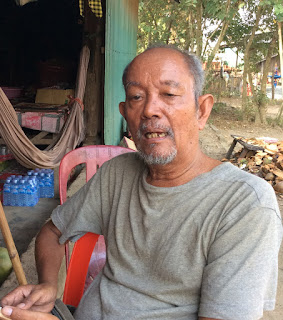 |
| Suon Som.photo taken by me 22nd January 2016 |
Friday, 4 December 2015
the haters are here
After the vote this week on action in Syria, the result of which I was very pleased to see (and Jeremy Corbyn was not, it appears) Labour MPs who voted with the Government, and some others who did not, have received death threats. Oh yes, pictures of guns and such like. One at least is under police protection now.
Do they think this is new? It is not. I was sent pictures of guns and knives, and gun-related pornography, and threatened with rape and murder, a number of times when I was an MP, and not to do with my vote on action in Iraq (in favour, since you ask). On the latter I had a lot of tedious whining from people who read the Guardian and didn't give a stuff about the slaughter in Iraq, and also some pacifist representations from people who thought there should be no military action anywhere, ever, by anybody. This last laudable, but impossible. No, the death threats came - you are ahead of me - when I mentioned Israel, which I did not do very often. I am a Zionist, but did not and do not go on about it. Also, ten years ago and more Jew-hatred was not so much in evidence on the left in the UK as it is now. But it was there. The death threats also came, slightly to my surprise, after I left Parliament (in 2005), and related to my support for Hillary Clinton rather than Barack Obama as Democratic candidate for the US presidency in 2008. I didn't expect misogynist hatred from that quarter, but I got plenty, and it was pointed out to me that Americans have guns, and that those guns would be used on me if I didn't shut up.
Well, I didn't cry about all that. I didn't like it, but I didn't cry. I certainly didn't ask for police protection. How wimpish is that? In my time an MP was seriously injured and his staff member killed by a mentally ill constituent with a samurai sword. Anyone in public life puts themselves in that kind of danger, and of course precautions must be taken, especially to protect staff. But - if you can't stand the heat, stay out of the kitchen, as someone once said. And if you don't make any enemies, it means you've never done anything. I don't know where the idea came from that we should all live and work in safe spaces. There are no safe spaces, and arguably if we try and keep ourselves safe all the time we place ourselves in more danger than if we don't - because we then think that nothing will ever happen to us. Yes, it might.
In my time communication was by email, and not everyone used even that. But I saw straight away that people were more willing to use hate speech in an email than they would have been in a letter, on the telephone or in person - though there was some of all that too. Even more so now, on Twitter. In public life you just get used to it. There's no rule that says everyone should be nice to you if you are an MP. In fact, to think that people should be nice to you borders on the narcissistic.
On Iraq (and there are similarities with the situation today as regards Syria, whatever anyone says) I voted with the Government, for military action, and never lost a moment's sleep over it, because I believed it was right, and was glad to have the opportunity to vote that way. I was very clear about that publicly. But there were still foolish letters in the local newspapers berating me for not voting with my conscience. As if voting with your conscience always means voting against the Government. I am glad I did not have to suffer the torments my neighbouring Labour MP Martin Salter had to at the time, desperately juggling two conflicting stories - in Westminster he said he was trying to persuade recalcitrant Labour MPs not to vote against the Government, because he wanteda government job to be helpful to Tony, and in Reading he said he was voting against the Government in line with his convictions and to appease the mosque show the people of Reading that he was on their side and not the Government's. In the end he was forced into the impossible position that everyone is forced into who tries to run with the hare and hunt with the hounds - he abstained on the vote, lied publicly in Reading about how he had voted, and was forced to stand down in 2010 when the issue refused to go away. I had none of that. I pretty much always tell the truth, not because I am especially virtuous but because it's so restful. You never have to keep your story straight or remember what you told the last person.
So, MPs who are worried and upset about the hate they are getting, and about possible threats to themselves and their families - relax. You probably don't need police protection. Once your home address becomes public you must either move house or put in very serious security measures, naturally. And vote with your conscience. It's the easiest way.
Do they think this is new? It is not. I was sent pictures of guns and knives, and gun-related pornography, and threatened with rape and murder, a number of times when I was an MP, and not to do with my vote on action in Iraq (in favour, since you ask). On the latter I had a lot of tedious whining from people who read the Guardian and didn't give a stuff about the slaughter in Iraq, and also some pacifist representations from people who thought there should be no military action anywhere, ever, by anybody. This last laudable, but impossible. No, the death threats came - you are ahead of me - when I mentioned Israel, which I did not do very often. I am a Zionist, but did not and do not go on about it. Also, ten years ago and more Jew-hatred was not so much in evidence on the left in the UK as it is now. But it was there. The death threats also came, slightly to my surprise, after I left Parliament (in 2005), and related to my support for Hillary Clinton rather than Barack Obama as Democratic candidate for the US presidency in 2008. I didn't expect misogynist hatred from that quarter, but I got plenty, and it was pointed out to me that Americans have guns, and that those guns would be used on me if I didn't shut up.
Well, I didn't cry about all that. I didn't like it, but I didn't cry. I certainly didn't ask for police protection. How wimpish is that? In my time an MP was seriously injured and his staff member killed by a mentally ill constituent with a samurai sword. Anyone in public life puts themselves in that kind of danger, and of course precautions must be taken, especially to protect staff. But - if you can't stand the heat, stay out of the kitchen, as someone once said. And if you don't make any enemies, it means you've never done anything. I don't know where the idea came from that we should all live and work in safe spaces. There are no safe spaces, and arguably if we try and keep ourselves safe all the time we place ourselves in more danger than if we don't - because we then think that nothing will ever happen to us. Yes, it might.
In my time communication was by email, and not everyone used even that. But I saw straight away that people were more willing to use hate speech in an email than they would have been in a letter, on the telephone or in person - though there was some of all that too. Even more so now, on Twitter. In public life you just get used to it. There's no rule that says everyone should be nice to you if you are an MP. In fact, to think that people should be nice to you borders on the narcissistic.
On Iraq (and there are similarities with the situation today as regards Syria, whatever anyone says) I voted with the Government, for military action, and never lost a moment's sleep over it, because I believed it was right, and was glad to have the opportunity to vote that way. I was very clear about that publicly. But there were still foolish letters in the local newspapers berating me for not voting with my conscience. As if voting with your conscience always means voting against the Government. I am glad I did not have to suffer the torments my neighbouring Labour MP Martin Salter had to at the time, desperately juggling two conflicting stories - in Westminster he said he was trying to persuade recalcitrant Labour MPs not to vote against the Government, because he wanted
So, MPs who are worried and upset about the hate they are getting, and about possible threats to themselves and their families - relax. You probably don't need police protection. Once your home address becomes public you must either move house or put in very serious security measures, naturally. And vote with your conscience. It's the easiest way.
Tuesday, 24 November 2015
Eve Babitz
 |
| photo Julian Wasser |
"The best capsule description of F. Scott Fitzgerald I ever read was a brief biography which began 'Francis Scott Fitzgerald was born in 1896 in St. Paul, Minnesota, and died 44 years later in Hollywood.'"
Read Eve. I'm your fan, Eve.
Friday, 20 November 2015
Shawcross and his unfashionable views
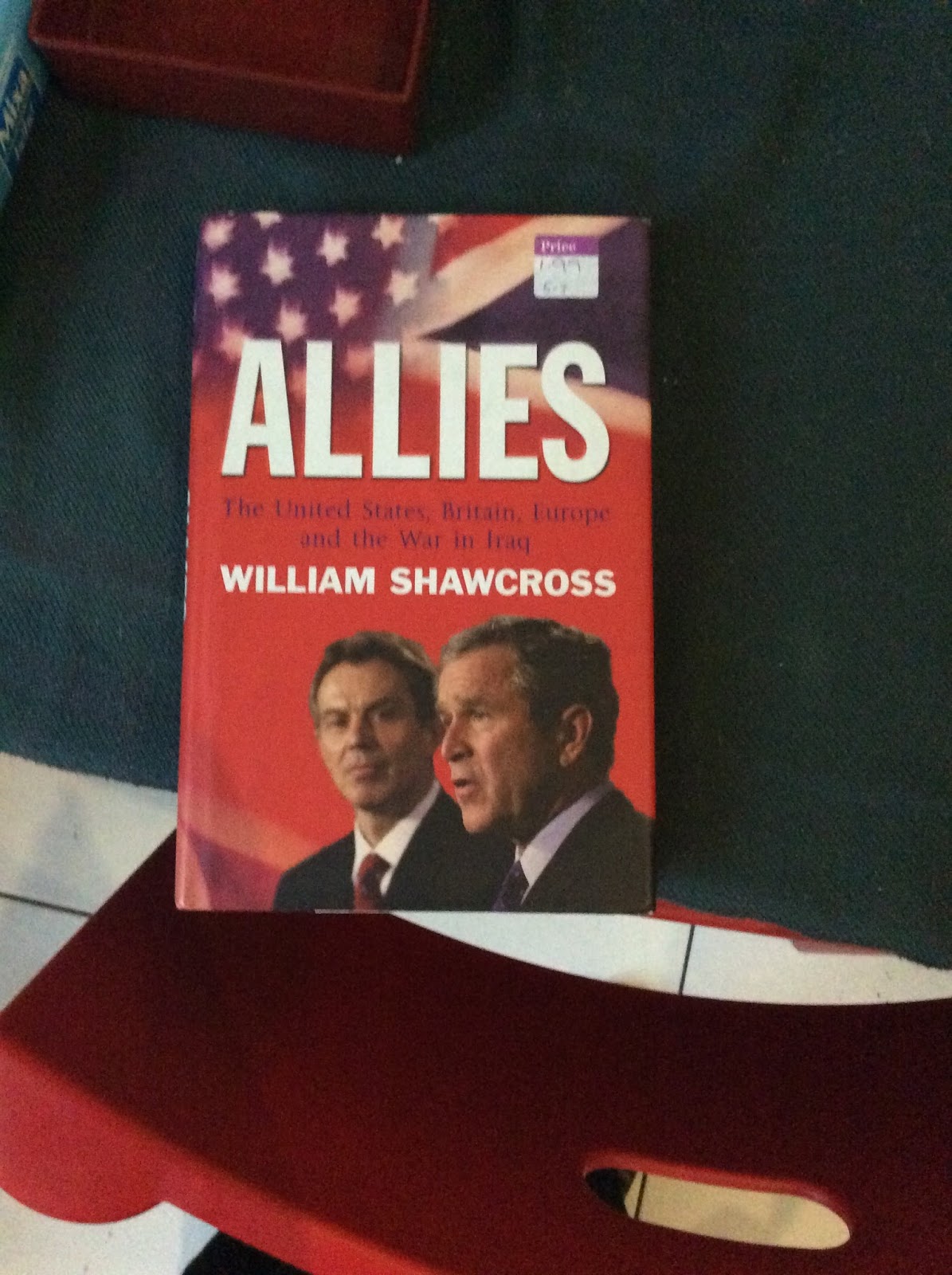
It starts this way: "The Arab narrative of the 'Fallujah butchery is ... pernicious nonsense." About 270 were killed in Fallujah, almost all of them fighters, almost all of those former Iraqi army officers under Saddam. He quotes the Iranian journalist Amer Taheri on the killing of the American hostage Paul Johnson at that time: "Paul Johnson was killed by lies spread by Arab elites ... he was killed by the over 1,500 Arab lawyers who have volunteered to defend Saddam Hussein but who were nowhere to be seen when he was engaged in genocide against the Iraqi people." Shawcross says "Saddam may not have been an immediate threat but he was an inevitable one." He notes (in his preface to a later edition) that the Arab Spring had its harbingers here, in 2003.
UN weapons inspectors were banned from Iraq in 1998, and the Allies bombed Iraq that year. Remember that? Remember the millions marching against it? Nor me. One member of my local Labour Party at the time timidly approached me to express disquiet about the bombing of a sovereign nation. But only one. UNSCOM's final report on this, in 1999, said that vast numbers of WMDs could not be accounted for. Shawcross goes so far as to give the need to contain Iraq in the 1990s as the reason for the presence of US troops in Saudi Arabia.
Shawcross is good on the humbug there is about the "neocons". At the time of that liberal hero JFK's presidency, in 1962, a legal opinion given by the Justice Department noted "the UN Charter does not prohibit the taking of unilateral preventive action in self-defence prior to the occurrence of an armed attack." No. It did not so prohibit then, and it does not now. Shawcross concludes "Surely everyone would agree that it would have been better if the United States had pre-empted 9/11 by confronting Al Qaeda and the Taliban before September 2001. There was ample cause." Yes.
Very few European intellectuals saw 9/11 as a threat. One who did was Ralf Dahrendorf (contrast the late Gunter Grass) who said that first, Western values do exist; second, power is needed to defend them; third, defence might have to be done by force of arms. Michael Ignatieff and Bernard Kouchner were two others who took this view.
"The Iraqis could not change their own tyrannical government; only outside intervention could do that. There was no better case in the world for such intervention. Tony Blair himself put the issue succinctly later when he told the House of Commons, 'When people say to me, why are you risking everything ... on this issue? I say I do not want to be the prime minister at whom people point a finger back in history and say: 'He knew perfectly well that the threats were there and he did not do anything about it.'"
I cite this book, and quote from it, to indicate that what "everyone" knows, and what "everyone" thinks do not really exist. What you think, and what I think, may differ. We may both find equally sound and convincing bases for our views, and argue them effectively. But a plurality of views there always is, and this must continue. At this time, soon after the savagery of the killings in Paris, and as I write in France under a state of emergency, there is a dismaying chorus of voices, at least in English, informing us what "everyone thinks" and what "everyone knows" - usually that such killings are the fault of "the West". That the Bataclan murders are France's fault for conducting air strikes on Islamic State. Leave them alone and they'll leave us alone. Idiocy. they have already declared war on "us". Hoping they'll leave us alone is like feeding a lion, in the hope that it will eat you last.
The West is at war,whether it wants to be or not. That war started a long time ago. It was formally declared much later, in the 1990s, and Bill Clinton did more or less nothing about it. It was stepped up in 2001, and it has been going on since. You and I cannot save ourselves from attack by Islamist terrorists. But if we shut up, if we blame the West for the attacks, if we say in Nick Cohen's ironic words "Kill us, we deserve it", we are complicit in the ultimate victory of the death-loving barbarians.
As I write there is a hostage crisis in Bamako, Mali. It is taking place at the Radisson Blu hotel in that city, whose guests are not that likely to be Malian farmers or workers. There are signs that it is about to be resolved without the bloodletting we saw in Paris a week ago. I hope so. But hey, that's only over there in Africa.
Subscribe to:
Posts (Atom)