This is a cracker of a read, as Robert Harris always is. A political thriller, and a courtroom drama, and while there are crucifixions and other kinds of torture aplenty, Cicero (for it is he the hero) does not perpetrate or get involved in any of them. Ancient Rome was bloody, but Cicero changed the world with words, and wit, and the lowest of cunning. This book, the first of a trilogy I am eager to finish reading, has been called "Labour in togas" and it's easy to see why. For anyone who was around the Palace of Westminster during the Blair years the parallels are unmistakable, and perhaps reveal more about Harris than he would like to have revealed. "If you find yourself stuck in politics, the thing to do is start a fight - start a fight, even if you do not know how you are going to win it, because it is only when a fight is on, and everything is in motion, that you can hope to see your way through."
Rather fun on political hatreds, too. There have always been politicians who simply hate each other. Of whichever politician it was said "He is his own worst enemy" and of whichever politician it was said that he replied "Not while I'm alive, he isn't" - well, that has been around down the ages, and still is today. In this he gives the lie to the Stoics, of whom Cicero, it seems, was a fan. I certainly am. Epictetus, my hero.
Showing posts with label Tony Blair. Show all posts
Showing posts with label Tony Blair. Show all posts
Sunday, 9 April 2017

Friday, 20 November 2015
Shawcross and his unfashionable views
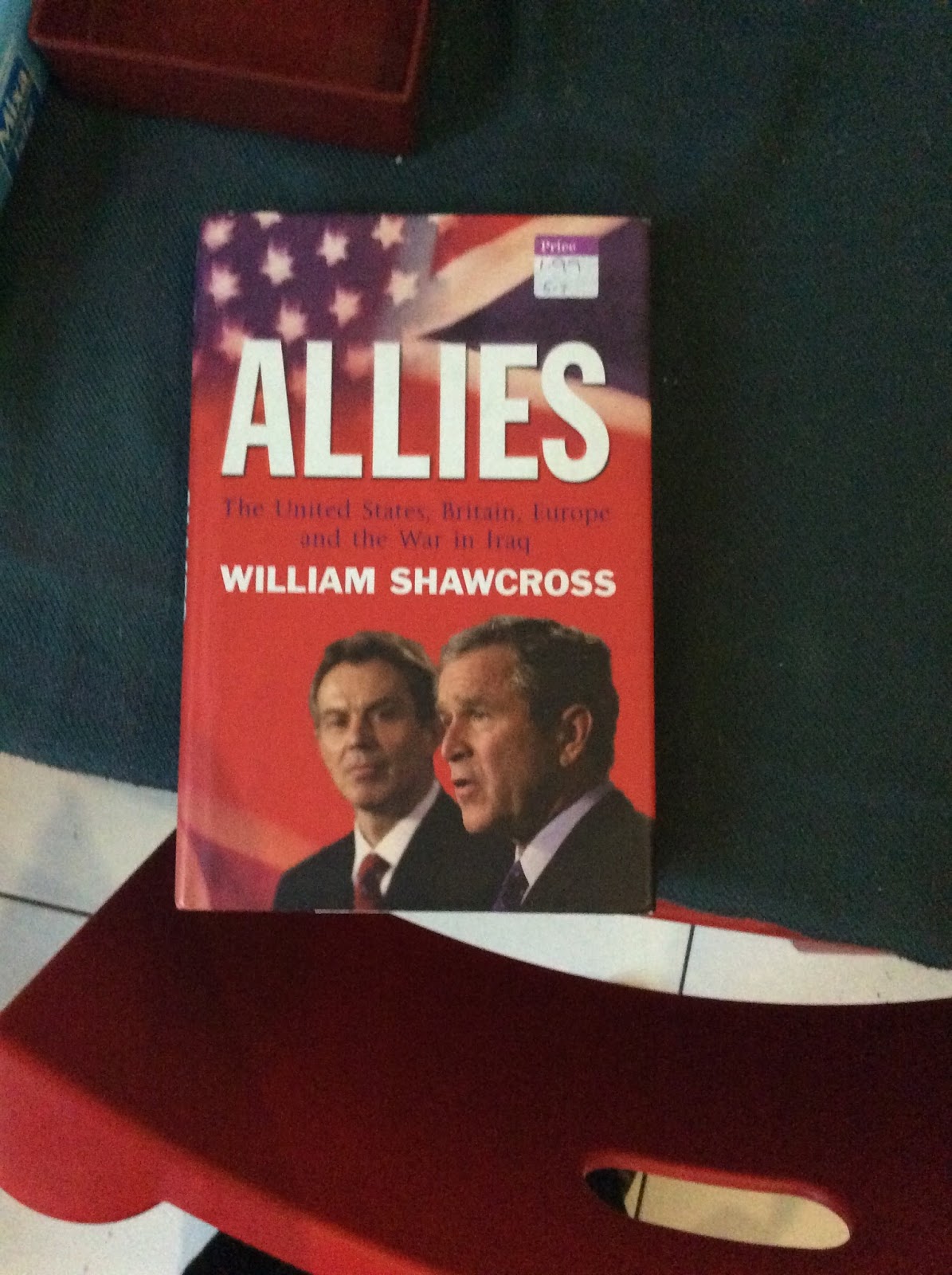
It starts this way: "The Arab narrative of the 'Fallujah butchery is ... pernicious nonsense." About 270 were killed in Fallujah, almost all of them fighters, almost all of those former Iraqi army officers under Saddam. He quotes the Iranian journalist Amer Taheri on the killing of the American hostage Paul Johnson at that time: "Paul Johnson was killed by lies spread by Arab elites ... he was killed by the over 1,500 Arab lawyers who have volunteered to defend Saddam Hussein but who were nowhere to be seen when he was engaged in genocide against the Iraqi people." Shawcross says "Saddam may not have been an immediate threat but he was an inevitable one." He notes (in his preface to a later edition) that the Arab Spring had its harbingers here, in 2003.
UN weapons inspectors were banned from Iraq in 1998, and the Allies bombed Iraq that year. Remember that? Remember the millions marching against it? Nor me. One member of my local Labour Party at the time timidly approached me to express disquiet about the bombing of a sovereign nation. But only one. UNSCOM's final report on this, in 1999, said that vast numbers of WMDs could not be accounted for. Shawcross goes so far as to give the need to contain Iraq in the 1990s as the reason for the presence of US troops in Saudi Arabia.
Shawcross is good on the humbug there is about the "neocons". At the time of that liberal hero JFK's presidency, in 1962, a legal opinion given by the Justice Department noted "the UN Charter does not prohibit the taking of unilateral preventive action in self-defence prior to the occurrence of an armed attack." No. It did not so prohibit then, and it does not now. Shawcross concludes "Surely everyone would agree that it would have been better if the United States had pre-empted 9/11 by confronting Al Qaeda and the Taliban before September 2001. There was ample cause." Yes.
Very few European intellectuals saw 9/11 as a threat. One who did was Ralf Dahrendorf (contrast the late Gunter Grass) who said that first, Western values do exist; second, power is needed to defend them; third, defence might have to be done by force of arms. Michael Ignatieff and Bernard Kouchner were two others who took this view.
"The Iraqis could not change their own tyrannical government; only outside intervention could do that. There was no better case in the world for such intervention. Tony Blair himself put the issue succinctly later when he told the House of Commons, 'When people say to me, why are you risking everything ... on this issue? I say I do not want to be the prime minister at whom people point a finger back in history and say: 'He knew perfectly well that the threats were there and he did not do anything about it.'"
I cite this book, and quote from it, to indicate that what "everyone" knows, and what "everyone" thinks do not really exist. What you think, and what I think, may differ. We may both find equally sound and convincing bases for our views, and argue them effectively. But a plurality of views there always is, and this must continue. At this time, soon after the savagery of the killings in Paris, and as I write in France under a state of emergency, there is a dismaying chorus of voices, at least in English, informing us what "everyone thinks" and what "everyone knows" - usually that such killings are the fault of "the West". That the Bataclan murders are France's fault for conducting air strikes on Islamic State. Leave them alone and they'll leave us alone. Idiocy. they have already declared war on "us". Hoping they'll leave us alone is like feeding a lion, in the hope that it will eat you last.
The West is at war,whether it wants to be or not. That war started a long time ago. It was formally declared much later, in the 1990s, and Bill Clinton did more or less nothing about it. It was stepped up in 2001, and it has been going on since. You and I cannot save ourselves from attack by Islamist terrorists. But if we shut up, if we blame the West for the attacks, if we say in Nick Cohen's ironic words "Kill us, we deserve it", we are complicit in the ultimate victory of the death-loving barbarians.
As I write there is a hostage crisis in Bamako, Mali. It is taking place at the Radisson Blu hotel in that city, whose guests are not that likely to be Malian farmers or workers. There are signs that it is about to be resolved without the bloodletting we saw in Paris a week ago. I hope so. But hey, that's only over there in Africa.
Friday, 2 January 2015
the wrong people were voting Labour
in 1997, apparently. Neal Lawson says so, and it's in the Guardian, so it must be true. A little light fisking to begin with.
Oh and Nealie babes, open letters are Always Wrong.
Extracts from this Guardian gem inside quotes. My remarks outside them. #thewrongpeoplewerevotingLabour - tell that to the people who were, and are, proud to be wrong. Now I must go and put some coal in the bath. Because that's what Labour voters do, isn't it Neal? Can't have nice clean Guardian readers in their leafy homes doing, can we? Because then we'd have Labour governments, and that would never do, would it?
Oh and Nealie babes, open letters are Always Wrong.
"Dear Tony,
You seem to be suffering an unusual bout of the dithers as 2014 ends and the year of the general election begins." Really? Having a say is dithering is it? Oh unless Tony says what the Guardian wants to hear. Silly old me.
"First you argue that Labour will lose if Ed Miliband rejects the third way. You fear a situation “in which a traditional leftwing party competes with a traditional rightwing party, with the traditional result”. " Yep. Spot on Tony. As even you seem to understand, Neal...
"But then you say you have been misinterpreted. " He was. Because he didn't say he didn't support Dead Ed, but was reported as having done so. "The words, though, seem pretty clear and you were always so good with words. And, apparently, at winning elections." Not apparently. He won three consecutive ones. No other Labour leader has done so.
"But we both know it’s not quite that clear or that simple. The truth is that any Labour leader could have won in 1997 – by then the nation was heartily sick of the Tories. It was time for change. Your great fortune was that the leadership came up just when most of the Labour party was desperate enough to accept victory at any price." Clearly you spent no time in Labour circles in the 1990s Mr Lawson, or you would know different.
"If he had lived, John Smith would have won in 1997 – not by as much as you, granted – but then your majority was too big, wasn’t it? " Was it? How big is too big? What would have been the correct figure? One that excluded the south of England? " I well remember crunching my way up gravel drives past BMWs in Enfield the day Stephen Twigg ousted Michael Portillo – oh, how we cheered later that morning. But in hindsight the wrong people were voting Labour. The tent was too big and you spent the next 10 years trying to keep the wrong people in it: the very rich, for example. What meaningful project includes everyone? " Any meaningful project does. You govern for all the people or you do not meaningfully govern at all.
"You remark, almost with pride, that the population hasn’t shifted to the left – well, what exactly was your job as a political leader supposed to be about then?
Had you not been so disdainful about anything remotely old Labour there would probably be much less support for Ukip now. True, you sneaked in some transfers to the poor in the shape of tax credits, and you introduced the minimum wage. " yes, you may well sneer about the minimum wage Mr L, your Guardian-reading dinner-party companions have no need of it, hein? "But never with a political flourish, never with a sense of moral purpose. It was all stealth and no one knew why they were better off" so- with more soundbites everything would have been better would it Neal?
"British politics is now crying out for a real choice. A society that is more equal, sustainable and democratic." Maybe so Neal, though I have my doubts that those notions are what most people are crying out for. Housing need and zero-hours contracts are their concerns, more like.
Extracts from this Guardian gem inside quotes. My remarks outside them. #thewrongpeoplewerevotingLabour - tell that to the people who were, and are, proud to be wrong. Now I must go and put some coal in the bath. Because that's what Labour voters do, isn't it Neal? Can't have nice clean Guardian readers in their leafy homes doing, can we? Because then we'd have Labour governments, and that would never do, would it?
Tuesday, 27 August 2013
the hand-wringing has to stop
says Tony Blair in The Times today (£). He is writing about Syria of course. Although the window of opportunity to achieve peace, stop the killing and prevent the various murderous death-lovers from dividing up the territory has long closed, largely because Barack Obama has been a TOTAL PUSSY, the line-ups of child body bags are embarrassing even him. Barack Obama is the leader of the free world. That phrase is rather unfashionable these days, but it is still true - perhaps more so, as during the Cold War, when half of Europe was under dictatorship, those dictatorships, while they locked up dissidents, told the world they were freedom-loving democrats. The likes of the Muslim Brotherhood, and worse, say no such thing. Osama bin Laden once said "We love death" and he spoke the truth. Tony Blair spoke of hand-wringing, but I haven't seen much of it. Indifference, yes. Hand-wringing is coming from people like me, I suppose, and I am powerless here. I have tried to test this notion on a few occasions recently, by raising the subject of the terrible slaughter in Syria with people who do not identify as political or interested in world affairs, and with whom I do not usually discuss such things. Without exception there has been a brief pause and then a change of subject. Almost pathological. What is going on here? It seems to indicate that a lot of people shut out what they know is happening, because, I suppose, they don't want to think about it, or feel guilty for doing and saying nothing. But they don't appear to articulate that to themselves. People who do articulate such things, often Americans, have been saying things like "This is not our war" - but even they have shut up a bit lately.
The excellent Terry Glavin puts it excellently:
"If NATO had leapt to this tremendous opportunity at the outset, Al Qaida's affiliates in Syria would have been smashed, Hezbollah would have been smashed, Assad would be gone and "the west" would have its best friend in the so-called Arab world, a new and embryonic democracy besides. Instead, more than 100,000 Syrians dead, Assad still in power and gassing his own people, Tehran is laughing at the U.S., Russia is ascendant, America is a laughing stock. A lovely new world, isn't it. "The tide of war is receding," as Obama likes to say."
The leadership of my adopted country of France, while it is f***ing up big time on retirement and the economy (another story) is saying, and in some cases doing, the right things internationally. Big up Francois Hollande. I might even card up for the Parti Socialiste again if this carries on. The UK is making the right noises. Even Angela Merkel has now said she would countenance action. Get in there. Do it now. The slaughter in Syria shames us all.
The excellent Terry Glavin puts it excellently:
"If NATO had leapt to this tremendous opportunity at the outset, Al Qaida's affiliates in Syria would have been smashed, Hezbollah would have been smashed, Assad would be gone and "the west" would have its best friend in the so-called Arab world, a new and embryonic democracy besides. Instead, more than 100,000 Syrians dead, Assad still in power and gassing his own people, Tehran is laughing at the U.S., Russia is ascendant, America is a laughing stock. A lovely new world, isn't it. "The tide of war is receding," as Obama likes to say."
The leadership of my adopted country of France, while it is f***ing up big time on retirement and the economy (another story) is saying, and in some cases doing, the right things internationally. Big up Francois Hollande. I might even card up for the Parti Socialiste again if this carries on. The UK is making the right noises. Even Angela Merkel has now said she would countenance action. Get in there. Do it now. The slaughter in Syria shames us all.
Tuesday, 13 August 2013
lies and the lying liars
I have mentioned before that I read a weekly magazine called Telerama, which is a kind of upmarket Radio Times. It is a TV guide, yes, but also a cultural guide to the week, and has articles on themes which are of varying interest. This being France, it has a depressing tendency to commission articles from philosophers who tell us how we think. Anyway, this week's theme is lying, and very interesting it was. I turned the pages to do a double take when I came upon a big picture of - Chris Huhne. Of whom nobody much has heard in France, but that story caused a small stir when reported here. This was because all he had done was acquire some speeding points (in France you start with maximum points and then they get deducted for things like speeding) and would only have had to pay a fine. Everywhere else in Europe, said Telerama, this would be a trivial matter which would bother no one. But Les Anglais cannot tolerate such a thing. Their public schools teach them the art of "la dissimulation" and understatement, so they do not have to lie. There's some truth in this, of course, but it's also true that British people tend to think that politicians lie, and in fact they mostly do not. People in politics cannot afford to lie, because of the consequences if they get caught. Myself, I found it simply easier to tell the truth, then you never have to remember to keep your story straight. Disappointingly, the article quoted the misguided John Le Carre, who has said that the important thing in British society is not to get caught. Which, of course, it is not. And then the article trotted out the "Tony Blair lied on Iraq" line as if it were true. That particular canard has never become the truth, despite the best efforts of the Guardian and others, because, er, it's not true.

Tuesday, 29 January 2013
the last liberal
I don't post often about American politics, largely because I am not very knowledgeable about it. But there are those in that world I admire, and Joe Lieberman is one of them. Read about him here as he prepares to leave the Senate. He is loathed by most of his erstwhile party, the Democrats, for supporting the Iraq War. Well, I have nailed my colours to that particular mast many times, so it will not be news to readers that I supported the Iraq War, that I voted for it enthusiastically in the House of Commons in 2003, and that I was, and remain, a Blairite and supporter of intervention in furtherance of democracy, human rights and the rule of law. I haven't always been that way, and went into the Commons in 1997 quite a long way from there. But it was Tony Blair, his leadership and especially the Chicago Doctrine, that helped me to see things differently.
People outside politics often forget, or do not realise, that there is such a thing as voting and acting on principle when that principle leads you to support the government of the day - and that voting against, or publicly opposing, the leadership line is not always principled, but is often done for cheap populist reasons. Joe Lieberman has always been a principled politician. In the end he stood, and won, as an independent. Perhaps there is a lesson to be learned from his political career. Maybe if you don't trim to your party's line, if you can't or won't, then outside the party is the place to be.
People outside politics often forget, or do not realise, that there is such a thing as voting and acting on principle when that principle leads you to support the government of the day - and that voting against, or publicly opposing, the leadership line is not always principled, but is often done for cheap populist reasons. Joe Lieberman has always been a principled politician. In the end he stood, and won, as an independent. Perhaps there is a lesson to be learned from his political career. Maybe if you don't trim to your party's line, if you can't or won't, then outside the party is the place to be.
Subscribe to:
Posts (Atom)